Monday, 26 March 2012

Joanneum Museum extension by Nieto Sobejano


From an Underground special on Dezeen.
Nieto Sobejano Arquitectos:
"Joanneum Museum extension and refurbishmentInternational Competition 1st Prize 2006Surface and DepthThe ground surface, the horizontal platform upon which most of our movements in the city occur, is very rarely the generating argument or the spatial support of a project. Perhaps as a result of that yearn for an identity that every new intervention seems to demand, architecture has tended to express itself throughout history by means of objects, volumes that have often established a difficult relationship with the scale of the urban environment in which they were inserted. In contrast, the extension of the Joanneum Museum emerged from the intention of acting within the strict limits of the horizontal plane of the city, offering a new public space based on an architectural proposal that is paradoxically simple in its depth and complex in its surface."
I find this approach inspiring and innovative. To me it questions what surface i am walking on, what am i walking on? It reminds me very much of Kevin Lynch's manifesto: Image of the City (1960) in which he breaks the city down into its elements such as; paths, nodes, landmarks, boundaries.
Which this approach, you really begin to question it as a user, the path, is this a path? a roof? what are the boundaries, does are these buildings linked ect. It sounds simple knowledge, but its something we don't appreciate enough. A journey in the city now is just the place inbetween where you are and where you want/have to be next.

The new proposed enterance was commissi by the surrounding 3 museum buildings, Museum of Natural History – from the 18th century –, the Regional Library of Styria and New Gallery of Contemporary Art, 19th century.
Large cones diffuse natural light and which is contrasted by shadows created through shade.
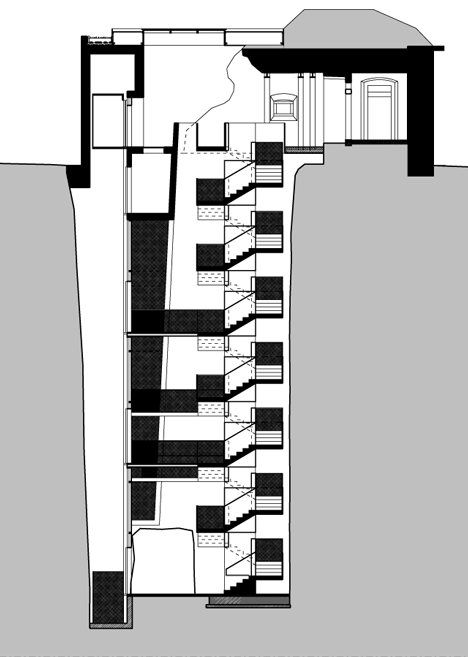
There is a sense of horizontal journeys through the underground structure but perforated openings on the ceiling offer views from above.

Friday, 23 March 2012

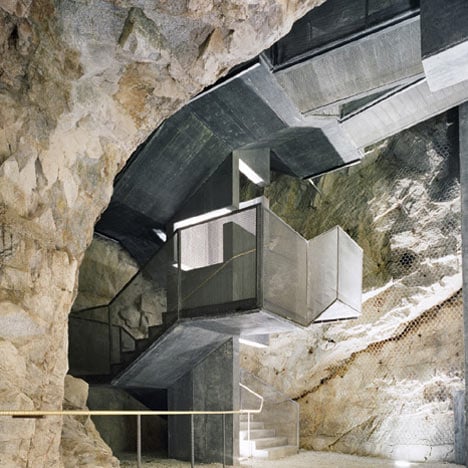
fortress of franzensfeste by markus scherer and walter dietl

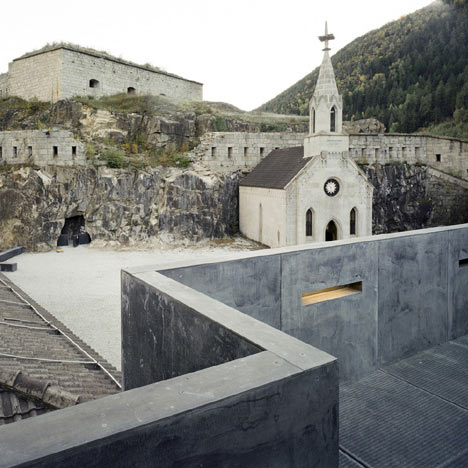
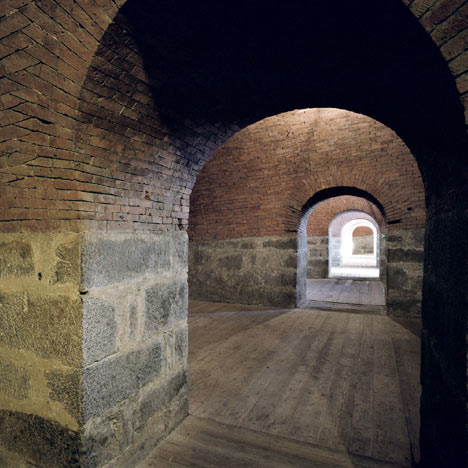
Masses of concrete and rock, interwinning and weaving throughout.
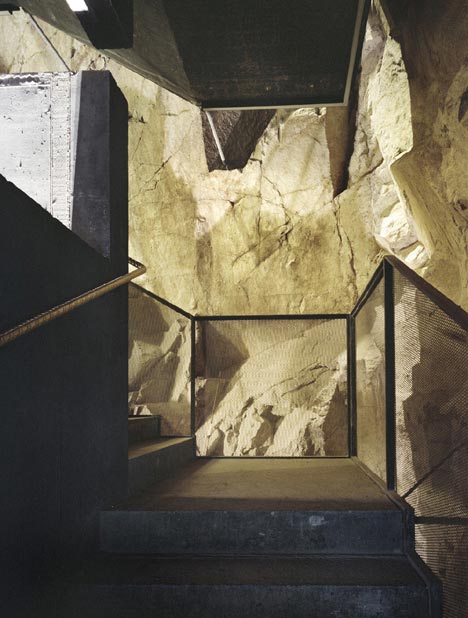
Fragile, sharp, exposed rock held back by netting.


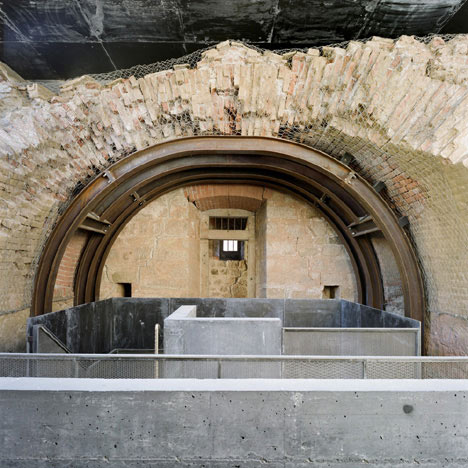
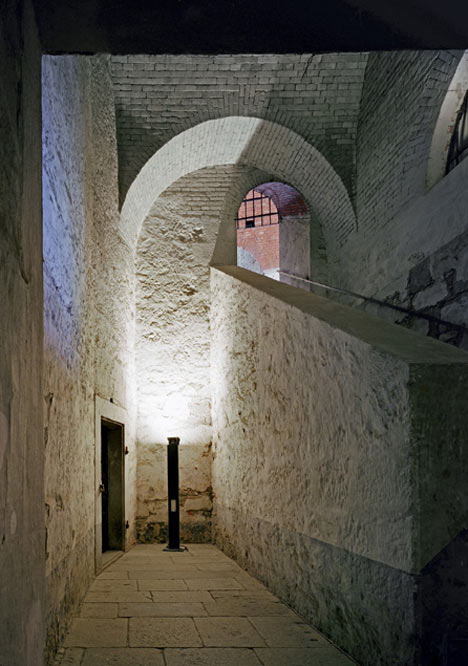
Evocative image of an enterance, two rusty curved I beams spreads the mass of the brick arch way framing the door.


Blurred boundaries between natural rock and gravel, and man made stone and concrete. Vast tones of grey work well with the dark perforations of hidden spaces, stories and ghosts.

Jerwood Gallery by HAT Projects

Contrasting finishes and rough tones for a pallette of colours to be displayed on it.


Clever exterior finish, Black glazed tiles, mimic brickwork but shimmer and dance with daylight.

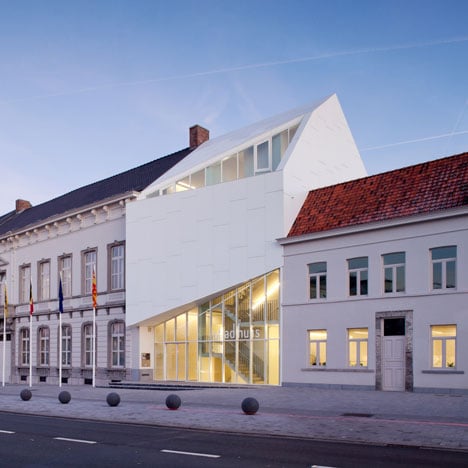
City Hall Harelbeke by Dehullu & Partners

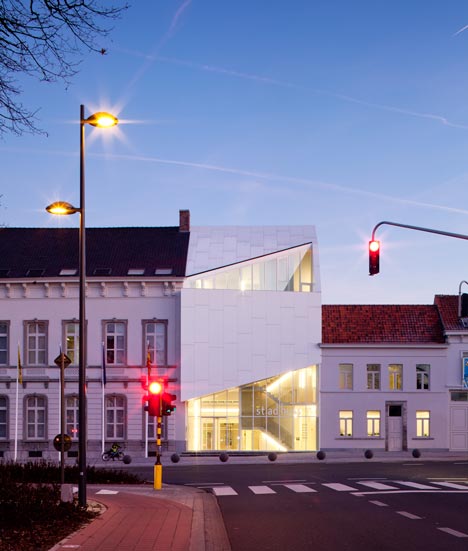
I love it boldness and dominance of light. What natural light it takes by day, it rewards its environment by night.

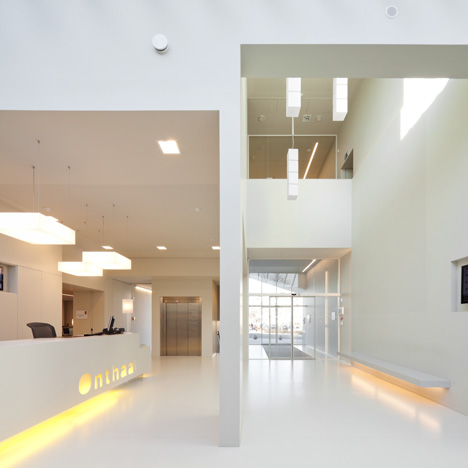
Same material treatment in contrasting light and ceiling height variations, but with different effects. The natural light is reflected whilst the artifical light is absorbed on the buidlings canvas.


Bold break away from the classical horizontal and vertical axis of lines set by in the immediate site with diagonal, both exterior and exposed interior. Subtle shadow in stairwell to offer some comfort of exposure to public.


Jamie Poole
Untitled
(2012)


This manifesto is the conclusion I have come to after recently been exposed to this exact form of communication to public and professional audiences. An often text based piece of text which conveys to the reader the persons; ideas, emotions, reaction, philosophy and/or theory. The short, compressed expression allows the reader to quickly tell what type of manifesto and/or how strongly they feel about their manifesto it is by the way the writing communicates.

I found frequently that I was could tell if I would dislike the manifesto after a short space of time, but I wasn’t sure why as I sometimes agreed with some of their points. It then struck me whilst reading Will Alsop’s ‘Towards an Architecture of Practical Delight (1993) one of which I found thoroughly refreshing and intriguing.

I found that between the manifestos I disliked and liked there was a clear distinction, although not apparent until the third set. The first category that I will call ‘I believe you have to do this.’ can be summed up with just two manifestos. The first Frank Lloyd Wright’s ‘Organic Architecture’ (1910) stated in the opening sentence, ‘…it is quite impossible to consider the building as one thing, its furnishings another and its setting and environment still another.’
(Wright, 1910) My first impression of Wright is him telling me that something is impossible, and this sets the tone of the Manifesto.

In the same set, Walter Gropius’s ‘Programme of the Staatliches Bauhaus in Weimar’ (1919) were he uses the term ‘must’ frequently throughout. It feels like an order, that to achieve what he has achieved you must do this, and I hate being told I can’t do this, or I should do that.

It’s not that I dislike Gropius or Wrights work, but simply the way they express themselves, which I understand, if you want to make an impact in the world, then possible you have to be quite blunt and harsh about your ideas in order to get people to listen.

The second category, I have called ‘I believe you don’t have to do that’ these manifestos suggest no boundaries neither limitations nor restrictions, but simply what you shouldn’t be constrained by. It begins to make you question yourself and everything around you. Without manifestos or visions such as these, the world would not have evolved so rapidly and certainly people would
not feel the need to be pushed beyond what is preconceived. It is also testament to the movements that are born to oppose something, just like the surrealist and modernism, situationists ect.

They include the works of Will Alsop, Philip Johnson and Lebbeus Woods. To me they open up a world for me to explore. Not show me the world they know. They don’t tell you what is acceptable or how things should be done, but offer a palette of which you I can own questions and responses. I feel these types of manifestos will help me grow. Personally, I don’t like to feel constrained, or put in a box, I feel most comfortable, productive and enthusiastic when absolutely anything is possible. New concepts, theories, styles (although this may have possibly been realized in the past) but I liked to find things out myself, then compare and evaluate and reflect.

It is from now that I refuse to be confined on a path, dictated by pre conceived ideas, but walk on the grass, wherever my mind shall take me. Creating freely, in the rawest possible state I know. I will no longer follow, but leave a trail to derail future student architects from this concrete path.